In digital marketing, you can often hear the term cloaking. Beginners in SEO and traffic arbitrage frequently ask: what is cloaking, why is it used, and why do websites and ad accounts get banned for it?
Put as simply as possible, cloaking is a content substitution technology where the same URL displays different versions of a page depending on who is visiting: a user, an ad reviewer, or a search engine bot.
Example of one page for different participants:
That is why cloaking in SEO and cloaking in advertising is considered a black-hat promotion method. Search engines and advertising platforms explicitly prohibit such manipulations.
Simply put: the website “disguises” itself as one type of content for review and shows something else to real users.
In technical terms, cloaking is a method of substituting page content based on user request parameters. It is a direct manipulation of system perception that creates an illusion of relevance where none exists, violating the user’s basic right to receive accurate information.

The goals of algorithms, advertisers, and users often conflict: moderation systems aim for safety, while resource owners look for ways to maximize profit by bypassing established rules. It is at this fracture point of interests that black marketing emerges.
In professional circles, you may hear slang terms:
In practice, several types of cloaking are distinguished. They differ in aggressiveness and purpose.
| Type | Description | Risk |
| Black | Complete content substitution for bots and users | Maximum |
| Gray | Partial optimization or hidden blocks with keywords | Medium |
| White (Conditional) | Content personalization by geography or device | Minimal |
Black-hat cloaking directly violates the guidelines of Google and advertising platforms such as Meta. This is the type most commonly used in traffic arbitrage schemes and black-hat SEO.
It is not just a redirect. The operating principle is based on filtering incoming traffic on the server side within fractions of a second. The system analyzes the visitor and determines who exactly opened the page. When a request reaches the hosting server, the server logic analyzes the visitor’s data packet even before page rendering begins.
To ensure system reliability, a combined approach is used, evaluating the following parameters:
Experts rate User-Agent effectiveness as low, while IP filtering combined with behavioral analysis (fingerprinting) is considered the gold standard of reliability in 2026.
Cloaking in SEO is used to manipulate search algorithms. Achieving high rankings through content that a human simply would not be able to read.

What the Google bot sees: It is fed text overloaded with keywords (keyword stuffing), hidden links, and massive semantic blocks. This is done to deceive ranking algorithms and make them believe the page perfectly matches a narrow query. What the user sees: A regular person clicking the link finds a page with minimal text, excessive advertising, or even content on a completely different topic.
Typical tasks:
Google considers such actions a violation of webmaster guidelines.
“Cloaking in any form violates our quality guidelines. There is no ‘white’ cloaking. We work to ensure that no one deceives or misleads our users” — this is the well-known position of Matt Cutts, former head of Google’s webspam team.
Hiding spam may provide a short-term boost, but as soon as the algorithm detects a mismatch in the hash sums of page versions, the resource will be removed from the index.
In CPA marketing, cloaking is most often used as a survival tool.
The goal is to bypass advertising platform moderation.
For example, ad networks prohibit promoting: gambling, betting, pharma products, crypto scams, adult content. To run ads, arbitrage marketers use traffic cloaking. A typical cloaking website looks like this:
| Parameter | White Page | Black / Offer Page (Target Page) |
| Audience | Meta/Google moderators, review bots, spy services | Target buyers (who passed the filter) |
| Content | Neutral (yoga blog, cooking site, business card site) | Aggressive offer (casino, weight loss, supplements) |
| Technical implementation | Full compliance with all rules (Terms of Service) | Data collection scripts, payment forms, aggressive UX |
| Objective | Extend account lifespan, pass review | Generate conversions and profit |
Let’s look at simple cloaking examples to understand how deeply a website can mislead:
If you are a website owner or an SEO specialist, it is important to understand how to check a site for cloaking.
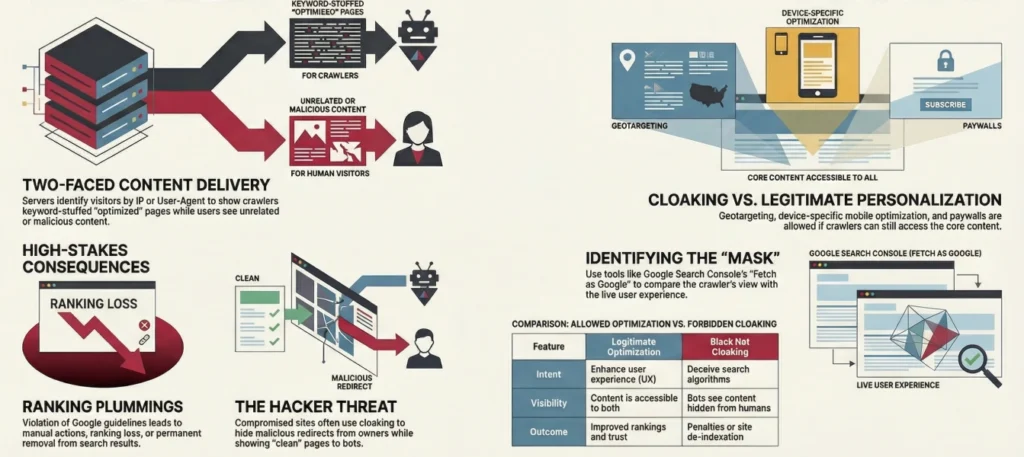
Main verification methods:
The question of how to check a site for cloaking is solved by comparing data from different sources. Remember: a professional cloak may filter requests even by IP address, so changing the User-Agent does not always work, and only Fetch via Search Console provides the truth.
This is how a basic website cloaking check is performed.
Despite its popularity in arbitrage, cloaking is associated with serious risks. For a reputable brand, using such methods is a path to self-destruction. Security systems (for example, Cloudflare) and Google’s proprietary neural networks are constantly improving.
Search engine algorithms continuously improve violation detection. Therefore, long-term use of such schemes almost always ends in sanctions. Below you can give a presentation (report) on the topic of the article.
To cloak means to use cloaking technology — that is, to show different content to different visitors.
From a platform rules perspective, it is a serious violation. From a legal standpoint, in most cases it is not a criminal offense, but it may fall under fraud or unfair competition laws if it causes harm to users.
The system analyzes user parameters (IP, User-Agent, browser language) and determines which page to display.
A cloaker is either a technical specialist who sets up a cloaking system (TDS) for arbitrage campaigns or black-hat SEO promotion, or the software script itself acting as a “smart gateway”.
This component compares incoming connection parameters against massive databases of search robots and moderators. If the system identifies an unwanted visitor (for example, a Google or Meta employee), it instantly replaces the target content with neutral content.
The phrase refers to a system designed to bypass Google Ads or Meta Ads moderation. By using google ads cloaking or facebook, webmasters also protect their profitable “bundles” from competitors. Monitoring systems (spy services) are often identified as bots and shown an empty “white page,” preventing them from copying successful creatives and landing pages.
Technically, it is possible, but extremely risky. Modern systems detect substitution through element load speed analysis and cookie verification. The chance of long-term survival for such a project is minimal. The risk of sanctions significantly outweighs potential profit.
Do not confuse prohibited masking with legitimate technologies.
If you aim to improve UX and make your site more user-friendly, you are safe. Cloaking, however, is always an intentional deception of the system that will sooner or later lead to the loss of the site and domain.
Enjoyed the article?

Discover ideas worth your time — stories,
trends, and tools that shape the future
Join our newsletter for curated
insights and important updates