Content:
In 2026, with the growing influence of AI algorithms and generative search, user intent has become a key metric that directly determines a website’s visibility and survival in search results. If a decade ago SEO was built around mechanical keyword matching, today Google and Bing rank meanings and entities.
Intent (user intent, search intent, query intent) is the user’s true motivation and goal behind the string of characters entered into the search bar. This is a key concept in SEO that determines why a user enters a query into a search engine. Understanding intent directly affects rankings, relevance, and content effectiveness.
Examples of search intent: to learn, to buy, to compare, or to navigate to a website.
Modern Google algorithms such as BERT and RankBrain use semantic search to interpret context and relationships between entities (brands, concepts, people). The search engine no longer simply looks for the word “Java” — it analyzes search history and neighboring words to understand whether the user is interested in coffee, the island, or the programming language. Moreover, understanding intent has led to the growth of Zero-click searches: when intent is fully satisfied directly in the search results through AI Overviews or Featured Snippets, depriving the website of a click but increasing brand authority.
Understanding why a query is made is the only way to reach the TOP.
Intent in SEO is not a marketing abstraction but a technical foundation that directly affects the semantic core and behavioral factors. Accurate intent matching reduces the bounce rate, increases page depth and time on site, signaling resource quality to algorithms.
From a business perspective, working with intent means optimizing the sales funnel. Ignoring the user’s goal leads to the “disappointed visitor effect.” For example, when a person at the buying stage lands on an informational article instead of a commercial product page.
Key benefits of intent-based SEO optimization:
Intent and SEO are directly connected: intent → relevance → rankings → traffic → profit
To build effective clustering, we distinguish five main types of intent. In addition to the classic four, in 2026 it is critically important to take into account Local Intent and a new paradigm — Prompt Intent (when the user does not simply search for information but delegates the search task to an AI assistant).
| Intent Type | User Goal | Funnel Stage | Typical Markers | Query Example |
| Informational (Know) | Gain knowledge, get an answer | Awareness | what is, how, why, tips, guide | “how to understand query intent” |
| Navigational (Website) | Find a specific brand | Awareness / Retention | brand name, sign in, login | “Datnera website” |
| Commercial (Research) | Compare, choose the best | Consideration | best, top, review, vs, reviews, what is the difference | “Which SEO service is better Ahrefs or SEMrush” |
| Transactional (Do) | Complete an action | Conversion | buy, price, order, download | “buy SEO audit” |
| Local (Visit) | Find a place nearby | Conversion / Visit | address, near me, metro, city | “SEO agency near me” |
| Mixed (General) | Get different types of answers: learn, compare, and/or buy | Awareness / Consideration / Conversion | broad general query, no уточнений, heterogeneous SERP | “SEO” Google may show both a services website (transaction), Wikipedia (info), and software for work (navigation) |
The methodology of professional analysis resembles the work of Sherlock Holmes: we look for “clues” that Google has already gathered after analyzing trillions of sessions.

Linguistic nuances in Bing and Google can drastically change the meaning even when the wording looks similar.
“Massage salon” vs “Massage room” in the first case, the intent is transactional (book a service). The SERP shows salon websites. In the second, it is often commercial/informational (renting a space, requirements for opening one, or furnishing ideas).
“New York’s phone” and “phone New York” have a huge difference: “New York’s phone” (directory, info) leads to area codes and databases. “Phone New York” is a transaction (buy a smartphone in New York).
“Cake” or “Order a cake” for the query “cake,” the search engine will offer recipes and photos (information), assuming you want to make one. “Order” is a direct purchase signal.
A mistake in identifying intent means wasting budget on content that will never reach the TOP due to architectural mismatch.

Website owners find it difficult to work with semantics on their own, so they hire an SEO specialist. When choosing one, it is important not to rely only on general promises but to ask specific questions: what cases have been implemented, how many years the specialist has worked in SEO, and most importantly — how they approach collecting relevant and target queries.
An experienced optimizer does not simply collect keywords but understands their meaning and alignment with search intent. A practicing SEO specialist can literally determine keyword relevance “at an intuitive level,” distinguish empty traffic from conversion traffic, and build semantics that truly bring in users who are ready to act.
To create a content strategy that addresses user pain points, use the formula: Intent → Structure → Value.
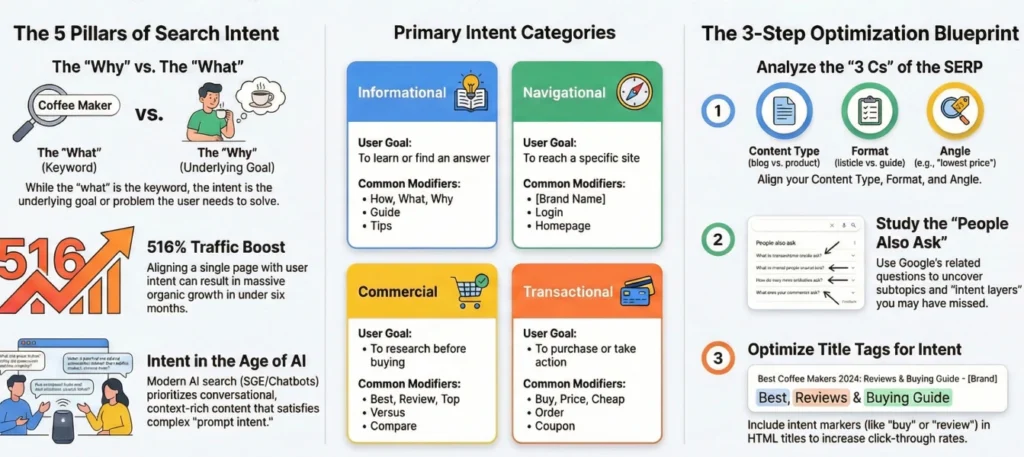
Search intent is always context, not just a keyword.
Success in modern SEO is not about manipulating search algorithms but about serving the user’s interests as precisely as possible. Intent has become the filter that separates high-quality, human-centered content from search spam. Choosing keywords for promoting a landing page is always about recognizing the user’s goal. With the development of generative search (SGE) and AI Overviews, the battle for intent will become even sharper: now it is important not just to attract a click, but to become the very source that AI cites when forming its response.
Review your semantic core and audit your clusters through the lens of intent today. Remember: the winner is not the one with more keywords, but the one who satisfies human needs faster and more deeply.
A page aligned with intent = a relevant page.
Below you can download a presentation on this topic. The PDF file was created to help you understand the article in simple terms.
It is the “why” behind a user coming to search: to learn, to buy, to find an address, or to find a specific website.
It is the main ranking factor that determines what type of content Google considers useful for a given user at a given moment. If your content does not match the intent, it will not rank at the top. Even a perfectly optimized page will not rank if it does not answer the user’s intent.
Informational (learn), navigational (find a website), commercial (choose), transactional (buy), and local (visit in person).
Analyze the TOP 10: if you see articles, the intent is informational; if you see products and prices, it is transactional; if you see a map, it is local.
An informational query looks for an answer to a question (“how to choose”), while a commercial query is choosing a specific option (“best models”).
Thanks to the development of AI search through ChatGPT, Gemini, Claude, and others, systems understand meaning and context. Optimizing for a “word” without taking meaning into account leads to losing visibility in search results.
Enjoyed the article?

Discover ideas worth your time — stories,
trends, and tools that shape the future
Join our newsletter for curated
insights and important updates