Can ChatGPT harm SEO? There are many extremes around this topic. Some are massively shifting content to neural networks, others fear penalties and traffic drops. The truth lies in the middle: search algorithms do not punish the mere fact of using AI. They evaluate the value of the text for the user.
Therefore, the question of whether chat gpt worsens a website’s SEO is not about the technology, but about the quality of implementation. The same tool can both strengthen promotion and collapse visibility.
The use of chat gpt for website SEO has become widespread for a pragmatic reason — resource savings. Where a team of copywriters used to work, an online space is now created where drafts can be prepared in a few hours.
Most often, neural networks are used in operational tasks: selection of low-frequency queries (semantics), preparation of article drafts or guest posts, generation of meta tags, product card descriptions, FAQ blocks. This speeds up page launches and closes “content gaps.”
But this is exactly where seo risks from chat gpt arise. When a business scales generation without control, texts begin to repeat in structure, arguments, and even tone.
Google directly states: “Automation is acceptable if the primary focus is helping users, not manipulating rankings.”
Fears did not appear out of nowhere. Early waves of auto-generated content already led sites under filters, even before the era of LLM and llms.txt.

Today concerns are linked to three things:
As a result, a danger for SEO arises when using gpt chat.
In short — yes. But the harm arises not because of AI, but because of weak content. This is exactly how the negative impact of gpt chat on SEO is formed.
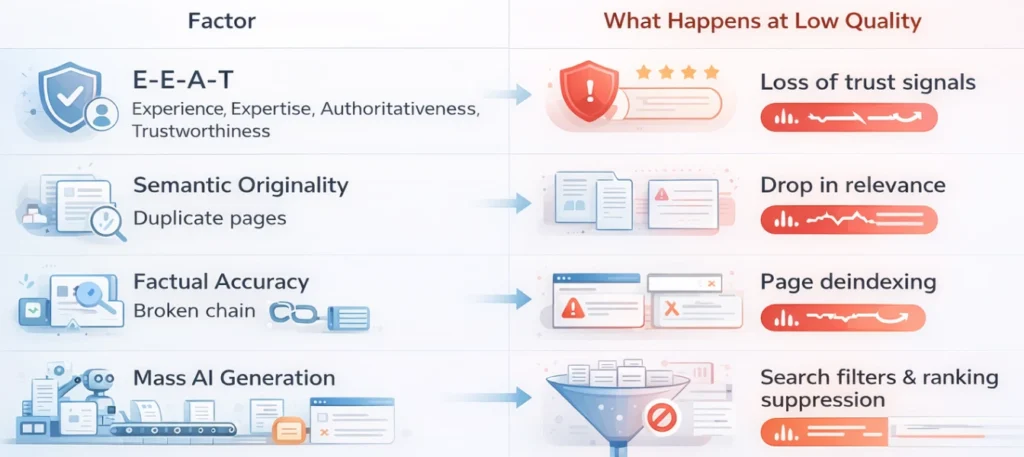
Algorithms analyze several levels of quality.
1. Depth of topic coverage
Automatically generated articles often describe basic things while avoiding practice. For Google, this is a signal of “low value.”
2. Experience and authorship
Content without expertise and experience passes E-E-A-T evaluation worse, especially in YMYL niches.
3. Scale of generation
Mass generation of content without editing reduces trust in the domain.
4. Factual errors
So-called hallucinations are cases when a neural network produces fabricated facts. The presence of such errors reduces the page’s quality in the eyes of search systems.
This is how AI content penalties and ranking drops are formed. Noticed your case? More details at the link: how to block AI pages from indexing.
Helpful Content Update is aimed at content created “primarily for search engines.”
For the impact of chatgpt on seo to be positive, AI must be integrated into the editorial cycle rather than replace copywriters.

The working model looks like this:
It is human review that removes the risks of abusing an AI chatbot for articles.
It is important to understand: not all AI content is equally risky. There are areas where automatic texts for SEO are safe by definition.
For example, meta tags. They are short, structured, and do not require deep expertise. The same applies to template product descriptions or idea generation for articles.
Practical case:
A marketplace implemented AI for 2,000 product cards + editing. Indexing accelerated, and organic traffic grew by 27% in six months.
Here, the consequences of working with Chat Gpt for the site were positive because quality control was preserved.
Can AI worsen website rankings? Yes — if it is template-based, inaccurate, and useless.
Content created by artificial intelligence is safe for SEO if it undergoes expertise, editing, and is improved with real experience. In this format, Chat GPT is not a risk but a driver of SEO production.
Yes, if you generated low-quality AI content without value.
Google algorithms analyze quality, not origin.
As a draft tool — yes. As the final author of an SEO article — no.
There are no mandatory requirements from search systems.
AI detection, editorial audit, content scoring.
Enjoyed the article?

Discover ideas worth your time — stories,
trends, and tools that shape the future
Join our newsletter for curated
insights and important updates