Content:
In the architecture of search engine promotion, links are not just “paths” between websites, but a complex system for transferring energy and trust. Imagine an elite scientific community: if a Nobel Prize laureate cites your work, your authority in science instantly skyrockets. But if you are mentioned by a freshman in their notebook — it’s nice, yet your status in the professional environment will not change.
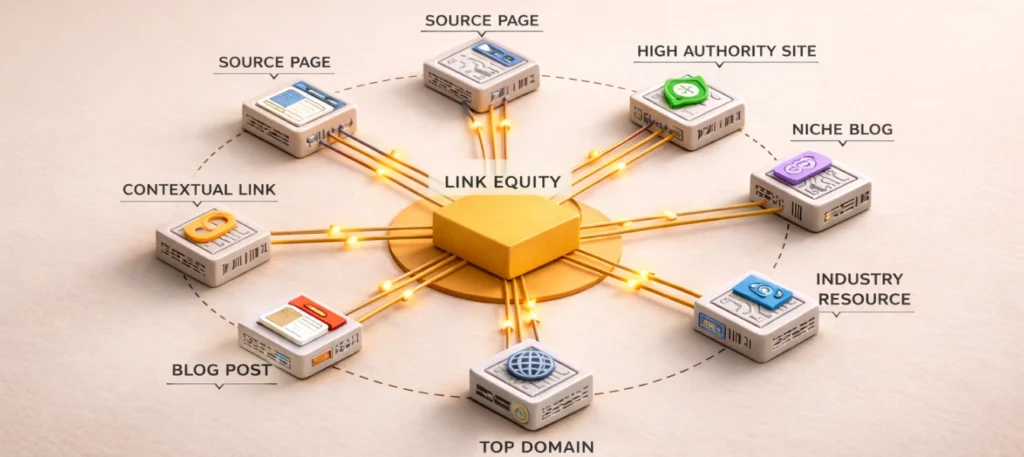
Link equity is the very measure of “recommendation” or “vote of confidence” that one page passes to another. In SEO, this mechanism is called Link Juice, emphasizing that authority literally “flows” through hyperlinks from the donor to the acceptor.
For Google and Bing algorithms, every SEO link is a signal that the content on the target page is useful and expert.
Link equity is a conditional indicator of the authority of a page or website, determined by the quantity and quality of external resources linking to them.
Many beginners make the mistake of trying to build up link mass — the simple number of links. But in 2026, it is not quantity that works, but link value.
It is important to distinguish the authority of a specific URL and the overall trust in a domain. Website link equity is the cumulative trust of the entire platform, while page link equity determines the strength of a specific publication.
| Characteristic | Page Link Value (Page Weight / UR) | Website Link Value (Domain Trust / DR) |
| What it evaluates | The authority of a specific URL address. | The overall reputation and strength of the entire domain. |
| Key metrics | UR (Ahrefs), PA (Moz), iPR (Netpeak). | DR (Ahrefs), DA (Moz), SDR (Serpstat). |
| How it changes | Depends on links pointing specifically to this URL. | Depends on the quality of the link profile of all domain pages. |
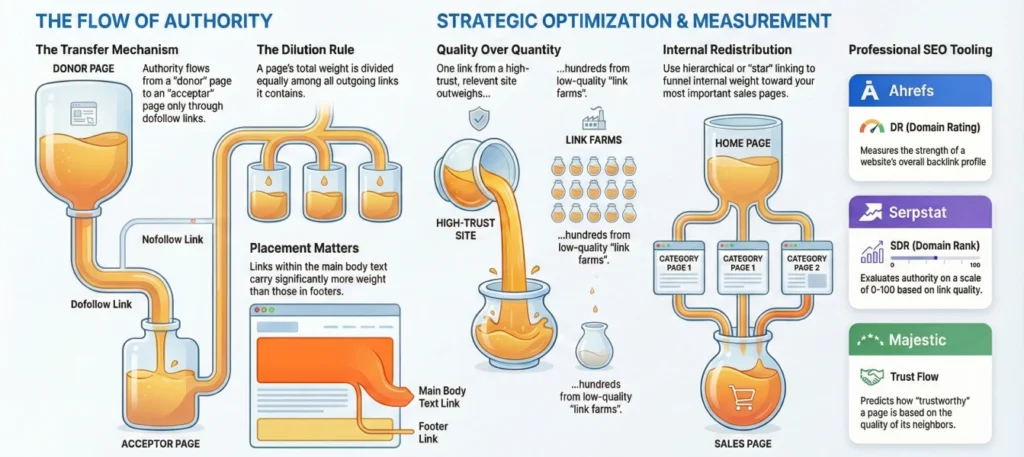
Damping effect and hierarchy: Usually, the page value of a website is maximal on the homepage. As you move deeper into the structure (categories → subcategories → product cards), the equity dissipates. So that important pages do not starve, they must be raised higher in the hierarchy or strengthened with direct internal linking.
The PageRank algorithm is a classic model of equity distribution. To find out the equity of a website, you need to understand the principle of its division.

Let’s imagine a website of 10 pages. Assign each an initial equity of “1.”
rel=”nofollow” does not pass equity directly, but it is extremely important for naturalness and dilution of the link profile.
To find out the value of a link, you need to analyze its link profile according to EEAT criteria (experience, expertise, authoritativeness, trust):
If external links are an inflow of energy, then redistribution of equity through internal linking is its competent use.
Main schemes:
Technical hygiene:
A website can be compared to a circulatory system: link equity works like blood, and internal linking works like vessels that distribute it across all URLs.
Many ask: how much equity a page has in absolute numbers? There is no exact answer from Google, but there are professional tools that measure authority:
| Tool | What it measures | Key feature |
| Google Search Console | External and internal links. | The primary data source of what Google sees. |
| Ahrefs | DR (Domain Rating) and UR (URL Rating). | The most accurate backlink database in the world. |
| Serpstat | SDR (Serpstat Domain Rank). | Authority evaluation on a 0–100 scale. |
| Majestic | Trust Flow and Citation Flow. | Allows you to distinguish “dirty” mass from high-quality mass. |
| Netpeak Spider | Internal PageRank (iPR). | Calculates equity concentration within the site and finds loss nodes. |
In 2026, we distinguish two states of link equity:
Search engines consider a link that no one clicks a “cold” recommendation. Dynamic equity is a signal that the link is alive and useful. For a backlink to transfer 100% of its potential, transitions must occur through it.
Here you can download a presentation (report) with a visually understandable overview of the article’s topic. Designed for beginning SEO specialists.
Link mass is the number of links, while link juice is their qualitative value. Mass describes the volume of the profile (number of donors), while equity determines the strength of each link’s influence on ranking.
The nofollow attribute blocks the direct transfer of PageRank. Google considers such links as a hint rather than an obligation to take them into account in ranking. In some cases, the search engine may use them to understand link structure, but you should not rely on link strength transfer through nofollow.
There is no fixed value. Equity is divided among all outgoing links on a page and depends on its own authority. The higher the donor’s authority and the fewer outgoing links it has, the more weight each will receive.
In the basic model — yes, but in reality additional factors are taken into account: link type, placement, attributes, and relevance.
Yes, the transfer mechanism is the same, but the initial authority of a donor page within a site is usually lower than that of strong external resources like Forbes, Wiki.
Yes. Links in the main content usually pass more equity than navigational or sitewide elements.
Yes. The more outgoing links, the smaller the share of equity each receives.
No. Google does not disclose the real PageRank, so indirect metrics (DR, UR, Authority Score) and comparative competitor analysis through SEO tools are used.
A 301 redirect passes most (almost all) link weight and ranking signals to the target URL, as it is considered a permanent redirect.
An authority indicator based on link structure and donor quality, independent of user behavior. Static value is calculated by algorithms based on the link graph and long-term domain characteristics.
It accumulates external brand mentions and is the central node of internal linking. Most external links lead to the site root, and the internal structure usually directs equity back to the homepage through the menu.
The influence of link text on the relevance of the acceptor page for specific keyword queries. Link text (anchor) helps the search engine understand the topic of the page it leads to, strengthening it for those words.
Enjoyed the article?

Discover ideas worth your time — stories,
trends, and tools that shape the future
Join our newsletter for curated
insights and important updates